
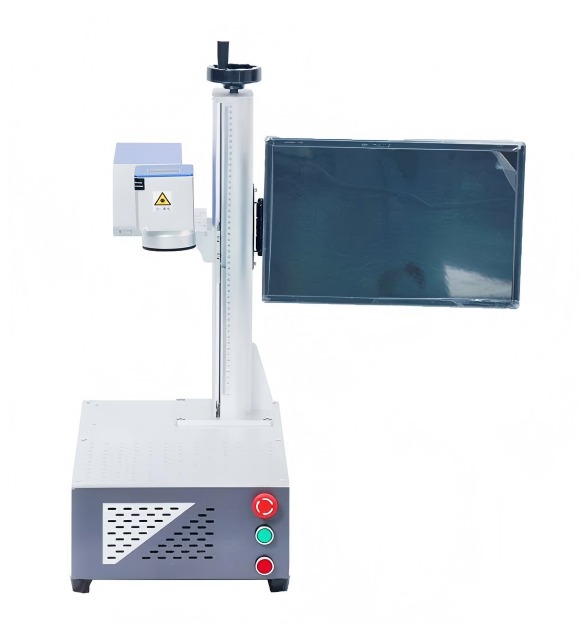
Why this question comes up: the physics
Portable and handheld laser markers exist for parts that cannot reach a bench: large workpieces, heavy parts, outdoor sites and field service. Accuracy comes from the optical path and galvo, not cabinet size - with equivalent optics a portable unit matches a bench-top for spot size and repeatability, differing in format, thermal headroom and continuous duty. Handheld suits large and heavy parts; portable suits frequently changing locations.
The answer and the process detail
It depends on the power configuration. Voltage swings are normal on industrial sites and there are two fixes: specify an internal supply with a wide input range, or add an external stabiliser or UPS. Air-cooled units can also be built with an external battery pack for off-grid work. We specify the power scheme to your site conditions - just tell us what the local supply looks like before ordering.
How to set it up and verify it
For continuous duty settle the cooling first: air cooling is more portable but strongly affected by ambient temperature, water cooling is stable but needs a reservoir and circulation, and dusty sites need intake filtration because dust on heatsinks trips over-temperature protection. Where mains voltage swings, specify a wide-input supply or add an external stabiliser or UPS; off-grid work can use a custom external battery sized to the longest single continuous run.
Selection and delivery
Choose on two conditions: how large the heaviest workpiece is, and whether mains power exists on site. For small-batch, high-mix work such as nameplates and tool marking a portable unit is entirely adequate and saves floor space; long high-volume runs still favour a bench-top. Recipes are saved per material and recalled on site, and we recommend locking parameters so only recall, start and stop remain. Full weight and cooling options are on the Portable Laser Marking Machine page.
Procurement Q&A
Price depends on the model (UV / fiber / CO₂), power, laser-source brand (Raycus / JPT / IPG) and configuration (galvo, field lens, control software). Zhongyi Laser lists the exact laser-source and galvo models on the quote and in the contract, so the configuration is verifiable and easy to reorder or replace later.
Standard machines ship in 7 days; rush orders in 3–5 days; custom non-standard builds in 15–30 days. Before production we confirm drawings, process and sample results to avoid rework.
18-month warranty on the machine. Core parts like the laser source and galvo are replaceable standard parts with long-term supply, so repairs and swaps are documented.
Yes. Send a sample and we return a real test video within 24 hours and ship the part back. Key models get a 48-hour aging test, so you see the actual result on your own workpiece before deciding.
Open Mo–Su 08:00–23:00 (GMT+8) with English support. Reach us at +86 159 9995 5734, WhatsApp +86 190 9874 6815 or Laurie@laserdg.com. Machines are packed to export standards.
We have 3+ engineers, 7+ authorised patents and 5000+ units shipped. Standard parts like laser source and galvo are stocked long-term for predictable replenishment.
It depends on the power configuration. Voltage swings are normal on industrial sites and there are two fixes: specify an internal supply with a wide input range, or add an external stabiliser or UPS. Air-cooled units can also be built with an external battery pack for off-grid work. We specify the power scheme to your site conditions - just tell us what the local supply looks like before ordering.
Yes, an external battery pack can be built in, and air-cooled units make it easier. Size it from duty cycle first: continuous laser output sets the battery capacity needed, and handheld units are generally designed for hour-scale runtime. Where mains or a generator is available, mains is the safer choice. Tell us the longest single continuous run you need and the engineer will size the pack accordingly.
Accuracy comes from the optical path and galvo, not the cabinet size. With equivalent optics, repeatability and spot size are the same as a bench-top unit. The differences are format, thermal headroom and continuous duty - portable machines trade these for weight, so they are less relaxed than a bench-top in long high-volume runs. For small-batch, high-mix work such as nameplates, a portable unit is entirely adequate and saves money and floor space.