The principle, in one line
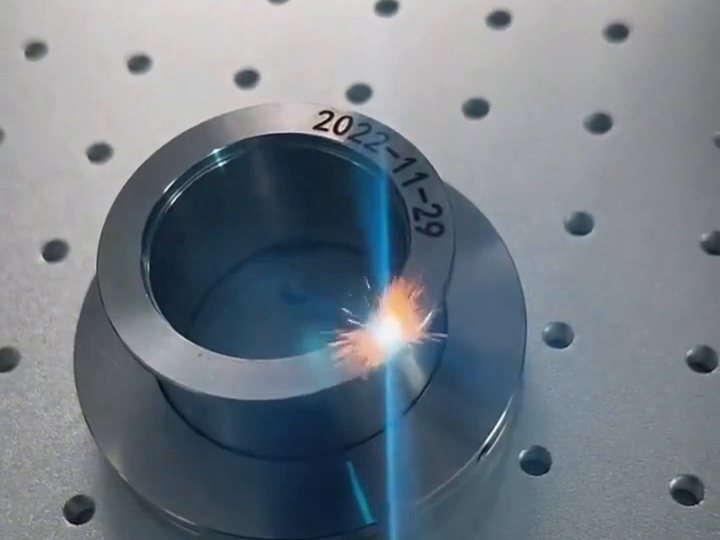
Laser marking is not printing. The beam is focused by a galvo scanner and a Field lens into a spot a few tens of microns across. At that spot the energy density is high enough to melt, vaporise or break the molecular bonds of the surface material. What remains is a permanent change in the material itself, not a layer sitting on top of it — which is why it survives abrasion, washing and solvents.
The first variable that decides what is possible is the wavelength. Absorptivity of the same material can differ by orders of magnitude across wavelengths — that is why one logo comes out crisp on one machine and faint on another.
Fiber · 1064nm · the workhorse for metal
- —Source: ytterbium-doped fiber laser at 1064nm, a photothermal process that melts or vaporises the metal surface.
- —Best at: stainless steel, carbon steel, aluminium, copper, plated metals, anodised aluminium, carbide — and some engineering plastics such as ABS / PC, subject to a sample test.
- —Common powers: 20 / 30 / 50 / 70 / 100 / 200W. More power means deeper engraving and higher speed.
- —MOPA models can mark in colour — oxidising the stainless surface instead of using ink.
UV · 355nm · cold processing, minimal heat
- —Source: UV laser at 355nm. High photon energy breaks molecular bonds — a cold ablation rather than burning.
- —Best at: glass, PC / PE and other plastics, pharma vials and food packaging film, silicon wafers, sapphire, ceramics.
- —Very small heat-affected zone: no yellowing, no burrs, ideal for fine characters, QR codes and micro-holes.
- —Common powers: 3 / 5 / 7 / 10 / 15 / 20W.
CO₂ · 10.6μm · for non-metals
- —Source: CO₂ gas laser at 10.6μm, strongly absorbed by organic materials.
- —Best at: wood, bamboo, leather, paper, cardboard, acrylic, glass surfaces, ceramics, and painted metal where the coating is removed.
- —Common powers: 30 / 60 / 100W, with the marking area matched to your part.
- —Results read as engraving or charring — usually high contrast on darker materials.
Which wavelength for your material
| Your material | First choice | Why |
|---|---|---|
| Stainless / carbon steel / aluminium / copper | Fiber 1064nm | High metal absorptivity; deep engraving, black marks; MOPA gives colour |
| Anodised aluminium / plated metal | Fiber 1064nm | Removes the plating, or shifts the oxide colour |
| Glass / crystal | UV 355nm | Cleaner edges; CO₂ also works and reads as frosted white |
| PC / ABS | UV 355nm | CO₂ works too, with a larger heat-affected zone |
| Pharma vials / food packaging film | UV 355nm | Ink-free, no migration, fine characters |
| Silicon / sapphire / ceramics | UV 355nm | Heat-sensitive materials needing fine detail |
| Wood / leather / paper / cardboard | CO₂ 10.6μm | High absorptivity on organics |
| Painted metal (coating only) | CO₂ 10.6μm | Takes the paint off to expose the metal |
| Something else | — | Send a sample; test video back within 24 hours |
Beyond wavelength
Two machines of the same power can perform very differently. The difference sits in four parts: the laser source (Raycus / JPT / IPG, chosen to your budget), the galvo scanner (speed and accuracy), the Field lens (marking area), and the control software (how fast you change over).
Zhongyi Laser states the exact laser source and galvo model on the quotation and writes it into the contract — so the specification can be checked and spare parts sourced later.
Not sure about your material?
Send us a sample. You get a test-marking video within 24 hours, and the sample back. See the result on your own part before deciding whether to order.